Saturday, March 19, 2022

On free speech (regarding the NYT editorial on 18 March)

I do not care for the framing of the New York Times editorial "America Has a Free Speech Problem" (18 March 2022). I find it self-contradictory and not advancing understanding of free speech.

It opens by claiming that "Americans are losing hold of a fundamental right as citizens of a free country: the right to speak their minds and voice their opinions in public without fear of being shamed or shunned" (emphasis mine). This doesn't seem accurate. Yes, people should have the right to voice their opinions in public; this is what is meant by "free speech." But we can't prevent them from "being shamed or shunned," since that would involve restricting someone else's freedom of speech to respond to them.

To more precisely address the Times' claim, we can't promise people they can live "without fear," since they could feel afraid for any reason or no reason at all, and they will have to address their own feelings. Here, I'm digging into a rhetorical flourish, perhaps a bit unfairly. Usually when people defend a right to live free of fear of X, they mean they want to change the world such that there is no longer any significant probability that X could harm them. They mean they want X not to pose any real threat so that no one can have a rational fear of X in their daily life. They do not mean in a literal way that society ought to somehow manage the contours of their private emotional world and apply a magic potion to remove their fears (both rational and irrational) so they can live unafraid.

But the word "fear" occurs six times in the editorial, plus once in the opinion poll they commissioned that is cited in the editorial. I think, then, they do mean to emphasize the importance of certain people being able to maintain a certain emotional baseline.

The Times says there is a "social silencing" that amounts to a "depluralizing of America." "However you define cancel culture, Americans know it exists and feel its burden," they say. They describe cancellation as a real thing: "People should be able to put forward viewpoints, ask questions and make mistakes and take unpopular but good-faith positions on issues that society is still working through — all without fearing cancellation." Again, "fear of retaliation or harsh criticism" is presented as the problem.

A flourishing individual life involves "the confidence to take risks, pursue ideas and express thoughts that others might reject," the Times writes. Fine — but this axiom reflects, first, a real possibility "that others might reject" one's ideas, absent which there would be no need for "confidence" at all. If the world became so thoroughly safe and affirming that we could be sure we'd never be shamed or shunned no matter what we said, speaking would incur no social "risks" and thus personal "confidence" would become a useless trait.

The Times says that, when we allow our own ideas to "go unchallenged by opposing views" and simply shut up or exclude those who air other ideas, our own ideas become "weak and brittle" and society as a whole forgets how to "resolve conflict" and may descend into "political violence." To some extent, this is true, although it depends what the ideas are and what the argument is about. This also seems to contradict the Times' original concern. When is a verbal challenge a form of healthy conflict, and when is it a form of unnecessary shaming and shunning? They simply switch gears without trying to locate the difference.

This sentence seems not correctly formed:

  • "But the old lesson of 'think before you speak' has given way to the new lesson of 'speak at your peril.'"

I don't see how one gives way to the other, falls short, or is abandoned. Rather, the two adages are complementary: think before you speak, and then speak at your peril. 'Speak at your own peril' might something like accept the reasonable consequences of your own words, including that people might not like what you say. The inevitability of consequences of some kind is the reason why we should think before we speak. Hey, and to add a third adage: if they have personal confidence with which to face that peril, they are living a flourishing human life, right?

If, by contrast, the Times meant to say that some consequences are unreasonable or disproportionate and thus that 'speak at your peril' amounts to a hostile threat, that claim needs to be better supported. They refer to "fear of retaliation" [emphasis mine] and interactions that "can result...in the loss of livelihood" [emphasis mine] but these hypotheticals don't clearly state nor demonstrate that any retaliation ever occurs at all, still less that it would be unreasonable or disproportionate if it did happen.

And it conflicts with another sentence:

  • "Many know they shouldn’t utter racist things, but they don’t understand what they can say about race or can say to a person of a different race from theirs."

If someone doesn't know how not to sound racist or offensive in other ways, it could well be because they haven't thought very much about their own speech, and thus they have not even tried to live up to the adage 'think before you speak' and accept the consequences of their own words. Certain people don't really believe in the value or use of thoughtfulness. Some perils can never be avoided and can only be prepared for, but insofar as their own speech imperils them, it's because they didn't think first and insisted on talking anyway.

The editorial continues:

"You can’t consider yourself a supporter of free speech and be policing and punishing speech more than protecting it. Free speech demands a greater willingness to engage with ideas we dislike and greater self-restraint in the face of words that challenge and even unsettle us."
Here, "policing and punishing" goes undefined, as does "protecting." Exactly how does an individual person go about "protecting" someone else's right to speech (especially if the speaker isn't currently facing any specific threat) and do so in a measurably greater way than they are "policing and punishing" (i.e. criticizing?) what the speaker is saying? The conundrum is clear when we consider that giving ourselves permission to challenge an idea with which we disagree is a way in which we exercise, and thereby protect, our own freedom of speech. When we challenge or otherwise express disagreement with someone else, we are not necessarily "policing" nor "punishing" them.

The Times recognizes that "the full-throated defense of free speech" has historically involved allowing individuals to express their of conscience, free from "the power of the government" (emphasis mine). Surely this does not mean that individuals need to avoid criticizing each other.

The Times says that only "a closed society" routinely sees the "attacking" of people "who express unpopular views from a place of good faith." I believe they mean verbal attacks here, since the editorial does not address physical violence, material damage, or threats thereof. And whether a view is popular or unpopular is, I believe, irrelevant to this discussion. I am not worried about the words "attacking" or "unpopular"; instead I want to focus on the phrase "from a place of good faith." How do we know whether a person really means what they say, and why should that give them more leeway to say it louder? If they say something offensive and they really mean it, doesn't that make it worse and more deserving of shaming and shunning? How did we move from think before you speak to speak from a place of good faith, the latter arguably a watered-down version of the former, accepting emotional intent as a substitute for intellectual effort?

Also perplexing is this: "Free speech is predicated on mutual respect — that of people for one another and of a government for the people it serves." That I have respect of some kind for someone else's existence does not mean I agree with everything they say, that I can ethically let it pass without comment, or that I can tolerate them saying it loudly over and over. Similarly, that I have respect of some kind for the government's existence does not mean I never criticize the government. In fact, I have to criticize a democratic government if I want it to continue to exist as a democracy, since without my criticism, our shared ideas ecome "weak and brittle" and society as a whole forgets how to "resolve conflict" and may descend into "political violence," as previously pointed out by the Times.

The Times ends on this note:

Every day, in communities across the country, Americans must speak to one another freely to refine and improve the elements of our social contract: What do we owe the most vulnerable in our neighborhoods? What conduct should we expect from public servants? What ideas are so essential to understanding American democracy that they should be taught in schools?
If this referred to an idealized society where everyone agreed on certain underlying principles, I'd agree. The problem in the actual USAmerican society is that many USAmericans believe that vulnerable people should be eliminated, that political leadership is about Twitter trolling rather than any meaningful kind of public service, and that fascism would be better than democracy. We do not agree on the basic principles so we are not able to have good-faith, informed debates about how to apply those principles.


For more, see this long Twitter thread (this is only one tweet from it):

Also this:

To read more on this topic, please see "Two Things 'Cancel Culture' Refers To", a 6-minute read. Or, try "What We Can Learn About Helen Joyce in Two Sentences", a 5-minute read. Those stories are on Medium, which lets you read a certain number of stories for free every month. You may also consider a paid membership on the platform.

Donald Sutherland acting in Invasion of the Body Snatchers

If you'd like to learn more about my work, I've published books. Also, I write for Medium. There, readers with a paid membership don't have to worry about the paywall.

Tuesday, March 15, 2022

An inscribed book of children's poetry: Did E. D. Cumming know Lincoln Kirstein?

One of the things about writing a biography is knowing when to stop. I published Ten Past Noon: Focus and Fate at Forty in 2020, but I keep learning things about Edward Dilworth Cumming.

misty trees
Image by noriyuki yagi from Pixabay

George Miller Cumming (1854–1927) graduated from Harvard College in 1876. He studied at Harvard Law for a few months in the fall of 1876 but then switched to Columbia Law. From 1877-1879 he traveled and studied in England, France, and Germany, and he was admitted to the New York Bar in 1881.

I have just found that George's son, Edward — "Ned," born 1901 — once owned a book of children's poetry and stories in German, Schnaken & Schnurren, by Wilhelm Busch and published in München in the 1860s-1870s. Ned's name was written inside it, along with the place name "Irvington." Eventually, the collection ended up in the hands of Lincoln Kirstein, born 1907, and who donated it to the Morgan in 1979. It's still available to see at the Morgan Library & Museum in New York City today.

I don't know if the two of them knew each other as children (though they were six years apart) and exchanged the book then, or if they did it later as adults, or if the two of them never knew each other at all and the book passed through a used bookseller — or, possibly, through their fathers.

The Cummings spent time at their Irvington home especially around 1915, though the home may have been in the family earlier than that. Ned may have been reading the children's poetry as a teenager to practice German.

Schnaken & Schnurren / von Wilhelm Busch ; eine Sammlung humoristischer kleiner Erzählungen in Bildern. I. Teil. Author: Busch, Wilhelm, 1832-1908. Published: München: Verlag von Braun & Schneider, [189-?] Gift of Lincoln Kirstein, 1979. E. Mühlthalers Buch- und Kunstdruckerei A.G., München--verso of lower cover. Edward Dilworth Cumming, Irvington--inscription in black ink on recto of fly-leaf. Dyrsen & Pfeiffer. New York. 16 West 33rd Street--bookseller's label inside upper cover. Binding: Publisher's pictorial cream colored paper boards, printed in black, blue, red, yellow, and green. Provenance: Edward Dilworth Cumming, inscription; from the library of Lincoln Kirstein.
Screenshot of the library catalog listing of Schnaken & Schnurren from the Morgan.

The question interests me because, while Cumming was a private person and I know nothing about his personal relationships, Kirstein was more prominent and knew famous people. While a Harvard undergraduate, Kirstein was a cofounder of the Harvard Society for Contemporary Art, along with his fellow undergraduates Edward Warburg and John Walker and a twentysomething PhD candidate, Alfred Barr, a bisexual man who was already lecturing on modernist art at Wellesley College. (This detail on Kirstein comes from Bad Gays: A Homosexual History.)

Rachel Maddow wrote about Lincoln Kirstein in her 2023 book Prequel: An American Fight Against Fascism. Kirstein, she says, was "Harvard educated, independently wealthy thanks to his father, bisexual, an unflinching aesthete, and a budding arts impresario," just like his colleague Philip Johnson, who was "an almost exact contemporary." But Kirstein was Jewish, and Johnson was a Nazi sympathizer. Maddow writes:

"While at Harvard, Kirstein had founded the society for Contemporary Art on campus, as well as a literary magazine that published new poetry by e.e. cummings, T. S. Eliot, Edmund Wilson, and Ezra Pound — before Pound was revealed as a committed fascist himself. While Johnson spent the first years of his professional life introducing Europe's modern design and architecture to America, Kirstein was busy creating an American ballet troupe to rival the best in Europe."

This was the New York City ballet, co-founded with George Balanchine.

Kirstein's father, Louis E. Kirstein, was, according to Maddow, "close friends" with Felix Frankfurter, a professor at Harvard Law who "spent the 1933–34 academic year at Oxford" and who wrote to FDR (they were friends) saying that England had a "sober" feeling like that which "preceded 1914." The younger Kirstein, Lincoln, "could sense ill winds blowing across the Atlantic and into the kinds of upper-class salons of Manhattan that welcomed rich, influential young men like him and Philip Johnson." And in New York at the end of 1934, Johnson "was losing sway at the Museum of Modern Art, where Lincoln Kirstein had started warning its key trustees, including Nelson Rockefeller and his mother, that the museum was in danger of being 'tarred with the Fascist brush.' Kirstein's whispered misgivings had also helped scuttle the Art, Inc., concessions at Rockefeller Center. Johnson's standing in New York was at a low, and he was working himself into a full-on snit about it."

There was an evening soiree in 1934 "at a stylish loft on East Fortieth Street," Maddow writes, with a "bohemian hostess," at which a drunk "wealthy socialite" guest told a Jewish guest that his people were corrupt and should be genocided. Though Kirstein wasn't there, the hostess reported to him the next day what had happened, explaining that she feared that antisemitism of the German intensity "might happen here in America."

In late 1934, Johnson and Alan Blackburn left New York for Louisiana to work for Huey Long. Maddow writes: "Kirstein had managed to keep his sense of humor about their weird fascist buccaneering," even when "Blackburn asked for Kirstein's latest address and then threatened to have him beaten up," but he always remembered "Johnson's nastiest remark to him." As he recalled in 1944 while serving in the Army: "He told me I was number one on his list for elimination in the coming revolution." However, as he continued in this letter, which was a character recommendation for Johnson, who was at risk of indictment for sedition: "Since being in the Army, I have seen Pvt Johnson frequently... I am convinced that he has sincerely repented of his former fascist beliefs, that he understands the nature of his mistake and is a loyal American." Maddow commented that this was "very generous," given that it would be "decades" before Johnson himself made "any statement of contrition."

In 1927, George Miller Cumming died, and around that time, his three surviving family members moved to the New York suburb of Scarsdale. Then, around 1937, when the owner of the house in which they lodged had a physical fight with the neighbors (political? we don't know), the three of them moved back to Manhattan. As I wrote in the book: "The Cumming family — Ned, his sister Emily, and their mother Lucy — had two apartments: West 116th Street and East 43rd Street. All three of them were associated with both addresses." I note the proximity of East 43rd Street to the party on East 40th Street where Kirstein's friends had gathered one night in 1934.

Though Louis Kirstein (1867–1942), who was born in New York, dropped out of school at 13, he later received honorary degrees from Harvard University and Boston University, and he became associated with Harvard Business School. His friend, Felix Frankfurter (1882–1965), who was born in Vienna, came to New York at age 12 and graduated first in his class from Harvard Law, where he was an editor of the Harvard Law Review. He began working for a law firm in 1906. That firm was Hornblower, Byrne, Miller & Potter; he was the firm's first Jewish lawyer, but he stayed there only briefly. (At that time, Lewis Bartholomew Woodruff, who had begun his law studies at Columbia in the 1890–1891 academic year, was a lawyer there; Woodruff had "full charge of preparation of railroad mortgages.")

George Miller Cumming, who served as the president of various railroads, was a law professor at Columbia from April 1891 to June 1897, so it's possible he encountered the young student Lewis Bartholomew Woodruff in 1891.

Ned Cumming died in 1940. Lincoln Kirstein died in 1996.

About these historical people

You can learn more about George and Ned Cumming in Ten Past Noon: Focus and Fate at Forty.

You can learn more about Kirstein in Lincoln Kirstein: The Published Writings 1922-1977. A First Bibliography and in Martin Duberman's The Worlds of Lincoln Kirstein. Chicago: Northwestern University Press, 2008.

Maddow says: "In the 2014 film The Monuments Men, Bob Balaban's character, Preston Savitz, is modeled on Kirstein."

Who worked at the library

"Belle da Costa Greene...was appointed the director and inaugural librarian of the Morgan, which was founded by J. Pierpont Morgan — the American financier. * * * Greene’s mother, Genevieve Ida Fleet Greener, separated from Belle’s father, Richard T. Greener, the first Black graduate of Harvard College, in the 1890s. * * * Genevieve dropped the last letter of their family name and was lighter-skinned enough to pass as white, as were Greene’s siblings.

This opened doors for Belle da Costa Greene in segregated America, and she worked at Princeton before joining the research library. There she met a cousin of J. Pierpont Morgan, who at the time was looking for someone to organize his growing collection.

* * *

Being a woman librarian and director of a major institution was a big deal at the time. Greene was able to achieve what most women could not, especially during a time when they had just gotten the right to vote."

The true story of a famed librarian and the secret she guarded closely, Jordan-Marie Smith, NPR, October 29, 2024

More about her:

Harriet S. Onderdonk, 1880

In 1880, Harriet S. Onderdonk became the first president of the Great Neck Library. It formally incorporated in 1889, and she remained on the board until 1904. One of her fellow library trustees at that time was Edward Morgan. (See this PDF from greatnecklibrary.org) "Great Neck," the document says, "inspired the creation of 'Gatsby' and 'West Egg'" in F. Scott Fitzgerald's imagination.

End of the line: 1866 marked the start of service of the North Shore Railroad (now the LIRR) from Flushing to the end of the line at the 'Thomaston' station in Great Neck. One of its largest stockholders was Mr. Messenger (father and grandfather of Library Board members, Emma and Elise Gignoux). For 46¢ each way, commuters could catch the lone train a day in each direction. They could leave Great Neck at 7:30 a.m. to Hunters Point where a ferry connected to the city. Return connection was from Hunters Point at 4 p.m. Twenty-three years later, the single track line from Great Neck to Port Washington was opened. More than 1,000 people called Great Neck 'home' by 1880. Land owners were engaged in commerce and agriculture, while merchants, shopkeepers and other villagers met the community's needs for goods and services. In the village were hotels, saloons, blacksmiths, carriage makers, a variety of stores and a volunteer fire department. Growth prior to 1900 was marked by the establishment of schools, churches, new roads, new modes of transportation, commercial enterprises ... and
the beginning of the Great Neck Library.

People paid a lot to belong, and they didn't stock just any book in the library.

Censored - The Three Musketeers:
Constant discussions were held on the quality of books on the shelves, comparing 'solid' reading, i.e. non fiction, to fiction. Each Board member was required to read and approve every book before purchase and those books that were considered 'unwholesome' didn't get to the shelves ... including The Three Musketeers. This form of censorship continued until 1900.
Money to run:
The Library's operating income was derived from membership dues and subscription fees. Membership in the Association, $10 per family, was by Board approval. In 1921, the fee was reduced to $1.

Where the Cummings were living in 1900

In my book, Ten Past Noon, I said the Cummings — George, Lucy, and five-year-old Emily (Ned wasn't born yet), plus maidservants — were living on 113 East 35th Street because that is what the census appears to say.

Upon review, I now wonder if the 1900 census taker misrecorded the address. The house number may have been 123, which belonged to Harriet Onderdonk. If so, the Cummings would have been renting it, and they would have vacated within a year, as that address, along with 125 next door, was sold in 1901 to banker James F. D. Lanier II. He built a new house for himself there.

123

New York Times, Feb 14, 1901. McVickar & Co, in conjunction with Collins & Collins, have sold for Mrs. Harriet S. Onderdonk the four-story English basement dwelling, 123 East Thirty-fifth Street, 16.8 by 98.9. The adjoining house, No. 125 sold last week through Collins & Collins, has since been resold.
New York Times, Feb 22, 1901. Pease & Elliman have sold for Park E. Bell the four-story dwelling 123 East Thirty-fifth Street, 16.8 by 98.9.

125

New York Times, Feb 2, 1901. Collins & Collins have sold for the estate of Sidney S. Harris to a client the four-story limestone English basement dwelling 125 East Thirty-fifth Street, 16.8 by 85 by 98.9.
New York Times, Feb 12, 1901. Pease & Ellman have sold for Park E. Bell, to an investor, for $32,500, the dwelling 125 East Thirty-fifth Street, 16.8 by 98.5.

Result

New York Times, July 10, 1901. Nos. 123 and 125 East Thirty-fifth Street, 33.4 by 75.2, for a five-story brick dwelling: J. F. D. Lanier, owner; Hoppin & Koen, architects; cost, $45,000.

No more emperors

"The concept of emperors, so firmly carved into the entirety of world history, collapsed over a few short years. The First World War began on 28 July 1914. By the time th war ended, on 11 November 1918, emperors were discredited beyond redemption. They were the way things always had been, but in a blink they were gone.
* * *
Empires were born when population growth caused egalitarian structures to break down. They ended when technology had grown to the point where warfare could no longer be tolerated. The imperial system, it turned out, was not the unarguable, unavoidable system of human organisation that it had been believed to be for most of history. It was a system that only functioned during a certain period of human and technological growth.
* * *
An absolute monarch was the omphalos around which the rest of society orientated itself. ... You knew what your role in the hierarchy was, and you orientated yourself accordingly. Without the omphalos of emperors, society was a jumble of different, relative, individual perspectives, all fighting for credibility and political power.
This is what was so remarkable about the changes that occurred in the first decades of the twentieth century. The sudden departure of emperors across huge swathes of the planet was the removal of single, absolute, fixed perspectives. This is a story we've already seen played out in different arenas. Art, physics and geopolitical structures all underwent similar revolutions around the same time, for seemingly unconnected reasons. Politicians were wrestling with the same challenges that faced Einstein, Picasso, Schoenberg and Joyce: how can we proceed, now that we understand there is no ultimate perspective that every other viewpoint is subservient to? How do we reconcile contradictory positions? When our previous ways of thinking are fundamentally flawed, how do we move forward?
* * *
Heisenberg's uncertianty principle...was discovered in 1927 when the German physicist Werner Heisenberg proved that knowing a particle's momentum made it impossible to know its position, and vice versa. The more accurate we are about one of a complementary pair of variables, the less it is possible to know about the other. ... it was Heisenberg's uncertainty principle that was as shocking to physicists as Gödel's Incompleteness Theorem had been to mathematicians. The problem was not that we didn't know the exact facts about physical reality, but that we couldn't know them.
The world of solid matter had turned out to be resting upon a bedrock as incomprehensible as the unconscious. Just as our conscious minds were only a bubble of rationality in a larger unconscious mind that we were usually unable to observe or understand, so the physical world of solid matter and comprehensible cause and effect was just a hiccup in a larger reality, produced by the quirk of a human-scale perspective. Mind and matter had both initially seemed understandable, but when we drilled down to find out what they rested on we found not firm foundations, but the unknowable and the incomprehensible. There was nothing down there that might conceivably come to act as our much needed new omphalos. Our world, both mind and matter, was a small bubble of coherence inside something so alien we haven't even been able to find adequate metaphors to describe it."
— John Higgs, Stranger Than We Can Imagine: Making Sense of the Twentieth Century, 2015

While we're here... related to the end of empires:

sahibzada mayed posted to LinkedIn on Nov 18, 2025: The word "polycrisis" sounds like "a sudden entanglement of isolated emergencies that make collapse seem accidental rather than convergence of centuries of colonial/imperial violence, domination, and extraction. ... What we call 'crisis' is also the unravelling of narratives that justify and legitimize harm: endless growth, human supremacy, resource extraction, militarized borders, and engineered scarcity." Try seeing this moment as "one of the many afterlives of empire."

Caspar Whitney

In 1920, Caspar Whitney became the president of the Audubon Society of Irvington-on-Hudson. (Bird lore v.24(1922), p. 433) Ned Cumming's mother attended an annual meeting on behalf of the chapter, so she may have known Caspar Whitney.

A couple paragraphs saying the local chapter was founded in 1920, a couple years later there were 140 members, and Caspar Whitney was the president.

As of this 4 May 1923 Irvington Gazette article, Caspar Whitney was still president.

newspaper clipping from Irvington Gazette

In 1930, Caspar Whitney wrote a biography of his wife (Florence Canfield)'s father, Charles Adelbert Canfield, an oil prospector in California who co-founded Beverly Hills.

Ned's mother, Lucy (Kittredge) Cumming, was also related to a Canfield family by marriage. Her sister, Sarah, had married George Folger Canfield. However, I don't see a shared ancestor between Charles Adelbert Canfield and George Folger Canfield.

FindAGrave:

Charles Adelbert Canfield (1848–1913), son of Orville Sillick Canfield (1816–1891), son of Sillick Canfield (1791–1865), son of Jonathan Canfield (1765–1851), son of Jonathan Canfield (1742–1829), son of Timothy Canfield (1700–1754), son of Ebenezer Canfield (1670–1716), son of Samuel Canfield (1645–1690), son of Matthew Canfield (1604–1673), who was born in England and came to Connecticut in midlife. Find a Grave: "He came over after his father Gregory's death in 1635."

George Folger Canfield (1854–1933), son of Albert Warren Canfield (1815–1879), son of James Canfield (1786–1841), son of David Canfield (1757–1804), son of Thomas Canfield (1717–1791), son of Israel Canfield (1684–1744), son of Thomas Canfield (1654–1689), son of Thomas Canfield Jr (1623–1689), who was born in England and came to Connecticut where he married and had children. Find a Grave: "He was born in Tring, England, the son of Thomas & Agnes Canfield of Hertfordshire, England."

Emily died at age 82 in mid-1977 in Peekskill — in a nursing home, as I recall reading somewhere. Looks like it was Field Home on Catherine Street in Shrub Oak, and apparently she'd lived there many years.

Field Home

"Field Home Raises $743 At Bazaar," Patent Trader, 24 November 1963:

"Corsages made for Westfield," Patent Trader, 15 December 1963:

The person named as Hermine Leger by Patent Trader may have been a medium. See p. 17 of this PDF. (January 25, 1951)

article about Rev. Hermine Leger

Psychic Observer, Jan 25, 1953, p. 15

Hermine Leger article 1953
Hermine Leger 1953 last sentence of article

Rev. Leger was still listed there as of 1955 and still in 1958.

Ancestry has a Hermine Leger who lived in New York and died in 1975.

Patent Trader unfortunately isn't digitized after 1974, so Emily's 1977 obituary (if it's in that paper) wouldn't be online.

Shrub Oak is an unincorporated place within Yorktown. The Yorktowner newspaper (1966-1978) would likely have carried her 1977 obituary. Try it on microfilm.

About me

If you'd like to learn more about my work, I've published books. Also, I write for Medium.

Sunday, February 27, 2022

In 'Middle Passage', a Slave Trader Battles the Idea of Truth

Ship by Iván Tamás from Pixabay

Charles Johnson's novel Middle Passage won the 1990 National Book Award. It is the story of a man named Rutherford Calhoun who flees his debts in New Orleans and embarks on a slave ship.

Calhoun is under the employ of Captain Ebenezer Falcon, a white man who has been a temple-robber in Africa and Asia and is currently a slave trader, one who introduces himself to his new sailor by saying “I don’t like Negroes.” A physical description of Falcon:

“between this knot of monstrously developed deltoids and latissimus doors a long head rose with an explosion of hair so black his face seemed dead in contrast: eye sockets like anthracite furnaces, medieval lines more complex than tracery on his maps, a nose slightly to one side, and a great bulging forehead that looked harder than whalebone, but intelligent too — a thinker’s brow, it was, the kind fantasy writers put on spacemen far ahead of us in science and philosophy. His belly was unspeakable. His hands, like roots.”

In Chapter 4 ("Entry, the fourth: June 28, 1830"), they have this dialogue. In short, Falcon argues that human beings think in binaries and that (whether by definition or some other inevitability) each of us believes ourselves to be correct. There is no fact of the matter, or at least not one that is accessible to us. We win arguments by force. Power alone determines who is right. We will never unite socially because we will never unite philosophically. The human mind is limited this way. Calhoun understands that Falcon is arguing for racism, and unfortunately Calhoun is unprepared to respond.

“You recall each [Ancillon, de Maistre, Portalis] says war is divine, as much a child of the soul as music and poetry. For a self to act, it must have somethin’ to act on. A nonself — some call this Nature — that resists, thwarts the will, and vetoes the actor. May I proceed? Well, suppose that nonself is another self? What then? As long as each sees a situation differently there will be slaughter and slavery and the subordination of one to another ‘cause two notions of things never exist side by side as equals. Why not — I put it to you — if both are true? Books live together in the library, don’t they, Teresa of Avila beside Aristippus, Bacon beside Berkeley? The reason — the irrefragable truth is each person in his heart believes his beliefs is best. Fact is, down deep no man’s democratic. We’re closet anarchists, I’d wager. Ouk agathón polykoíranín eis koíranos éstos. We believe what we believe. And the final test of truth is war on foreign soil. War in your front yard. War in your bedroom. War in your own heart, if you listen too much to other people. And in each battle ’tis the winning belief what’s true and the conquerer whose vision is veritable.”
“No — nossir!” says I, louder than I intended. “By my heart, sir, if something is true, it can’t be suppressed, can it, regardless of whether all the armies of the world stand ready to silence it?”
“You’re a smart boy. What d’you think? Is truth floating’ round out there in space separate from persons? Now, be frank.”
“No, but—“
“Conflict,” says he, “is what it means to be conscious. Dualism is a bloody structure of the mind. Subject and object, perceiver and perceived, self and other — these ancient twins are built into mind like the stem-piece of a merchantman. We cannot think without them, sir. And what, pray, kin such a thing mean? Only this, Mr. Calhoun: They are the signs of a transcendental Fault, a deep crack in consciousness itself. Mind was made for murder. Slavery, if you think this through, forcing yourself not to flinch, is the social correlate of a deeper, ontic wound.”

Later, in Chapter 5 ("Entry, the fifth: June 30, 1830"), Falcon tells Calhoun about his interpretation of the religious beliefs of the Allmuseri, a fictional West African tribe.

"Being unphysical means there can only be one of each kind of god or angel — one Throne, one Principality, one Archangel, ‘cause there’s only a formal (not a material) difference amongst ‘em, so the one below is the only creature of its kind in the universe — is the universe, the Allmuseri say...Another thing ‘bout not been’ physical most of the time is that it can’t understand any of the sciences based on matter, like geometry.”

Such a god has limitations and contradictions. Falcon continues: “For example, a god can’t know its own nature. For itself, it can’t be an object of knowledge. D’you see the logic here? The Allmuseri god is everything, so the very knowing situation we mortals rely on — a separation between knower and known — never rises in its experience.” So, too: “Omnipotence means, ironically, that it can create a stone so heavy it cannot lift that same stone from the floor.”

In the story, Falcon does battle with the god of the Allmuseri in a literal, physical way, which is narratively surprising but philosophically unsurprising in retrospect.


If you'd like to learn more about my work, I've published books. Also, I write for Medium. There, readers with a paid membership don't have to worry about the paywall.

Monday, January 24, 2022

We do a lot of logical work to come up with our definitions

Reading Ernest Gellner on logic.

Some people at the turn of the 20th century hoped: “if only the whole of logic and mathematics could be deduced from a limited set of safe premisses, the whole edifice would thereby be made trustworthy.” But now “the ideal itself has lost its appeal and authority.” W. V. O. Quine, for example, says (Gellner’s paraphrase) that “even in logic, our premisses cannot insure us against future surprises and the need to retrace steps” and that we “haggle and weigh advantages, risks, and convenience, rather than move rectilinearly in marble halls along pathways of clear and indubitable truth.” Logic, too, will “retrace steps, make opportunist and revocable choices, use anything that happens to be close to hand,” just like Lévi-Strauss’ prehistoric bricoleur, that opportunist neolithic handyman who ‘makes arrows from any timber that is close to hand’.” (p. 6)

Meanwhile, the philosopher of mathematics Imre Lakatos maintains, in Gellner's paraphrase, that

“definitions follow rather than precede proofs. Objections to proofs can only be raised and understood after the proof has been formulated; the refinement of the proof in the light of the objection leads to a reformulation of the initial concepts, with a view to weathering the objection or modifying the conclusion. The fully refined and powerful definitions of the initial concepts, and hence the axioms formulated through them, are only the fruits of many, many repetitions of this process. The definition, the official premiss, comes one at the end, not at the beginning — and even this end is only an interim one. The process can never be known to be complete, and indeed is unlikely ever to be terminated. Moreover, the order in which these sequences occur — proof, objection, redefinition — is not something contingent and accidental, something that only happens in the rough work and can be left out in the clean copy; it is, on the contrary, essential to and inherent in the very nature of mathematical discovery. The messy, insecure, step-retracing procedure is of the essence of the subject.” (p. 6–7)

Ernest Gellner, Legitimation of Belief Cambridge University Press, 1975.

A brain with a wordcloud of terms about thinking
Image by johnhain on Pixabay

If you'd like to learn more about my work, I've published books. Also, I write for Medium. There, readers with a paid membership don't have to worry about the paywall.

Thursday, January 6, 2022

Quotes: What role does ideology play in our thought?

Passages I've come across on how ideology influences thought.

A crowd of people.
Image by Graehawk on Pixabay.
Quotes:
Democracy is premised on the belief that we can trust ordinary people to make consequential decisions. It’s in some ways an enlightenment ideal premised on another enlightenment ideal: the triumph of reason and the capacities of ordinary people. To buy into it, you have to believe that people will be more loyal to principles and discernment than to leaders and groups, and in that sense, democracy has always been a risky project. If democracy requires independent-minded people who can reason well, autocracy requires the opposite, people who will obey orders about what to think as well as do.
"Why Republicans Keep Falling for Trump’s Lies." Rebecca Solnit. New York Times. Jan. 5, 2022.
Now, credulity does not stand alone. In turn, it is part of an attitude called dogmatism — the belief in and defense of "truth." Those who believe strongly in "truth" will try to find it through the mechanism of belief. We are today a "belief explosion" which throws skepticism to the winds and attaches itself in a credulous manner to mental malpractice and intellectual humbuggery of every kind — to faking it, small and big. Without dogmatism, the Fake Factor could not exist. Because of dogmatism, that ancient enemy, everything goes, or very nearly.
Arthur Herzog. The B.S. Factor: The Theory and Technique of Faking It in America. (1973) Baltimore, Maryland: Penguin Books Inc., 1974. p. 183.
Constant development is the law of life, and a man who always tries to maintain his dogmas in order to appear consistent drives himself into a false position. That is why Emerson said that foolish consistency was the hobgoblin of little minds... * * * A devotee of Truth may not do anything in deference to convention. He must always hold himself open to correction, and whenever he discovers himself to the wrong, he must confess it at all costs and atone for it.
Gandhi. Young India, March 2, 1922 and September 20, 1928. Quoted in Louis Fischer's 1962 book The Essential Gandhi
No ideology can tolerate a full historical consciousness. Only realism can...
Clive James. Cultural Amnesia: Necessary Memories from History and the Arts. (2007) New York: Norton, 2008. p. 44.
Our fearsome gods have only changed their names: they now rhyme with ism.
C. G. Jung. Aspects of the Feminine. (Collected Works.) Translation by R. F. C. Hull. New York: MJF Books, 1982. p. 93.
For an ideology differs from a simple opinion in that it claims to possess either the key to history, or the solution for all the "riddles of the universe," or the intimate knowledge of the hidden universal laws which are supposed to rule nature and man.
Hannah Arendt. The Burden of Our Time. London: Secker and Warburg, 1951. Published in the US as The Origins of Totalitarianism. p 159.
Ideology functions as a machine to destroy information, even at the price of making assertions in clear contradiction of the evidence.
Jean-Francois Revel, La Connaissance Inutile, p. 153. Quoted in Clive James. Cultural Amnesia: Necessary Memories from History and the Arts. (2007) New York: Norton, 2008. p. 605.
In 1897, French sociologist Émile Durkheim theorized four different types of suicides — the egoistic, the altruistic, the anomic, and the fatalistic —
I love how sure and clear these words sound. I love anything that breaks suffering down into a clean taxonomy you might look to when lost and nod your head in the performance of understanding.
sam sax, Yr Dead, San Francisco: McSweeney’s, 2024. p. 207.

And people distinguish cis and trans:

Katelyn Burns, Oct 24, 2025:

"...this week, a federal judge in Mississippi overturned an Obama era rule mandating that health care providers and insurers can not deny trans people gender affirming care if that same care would be available to cisgender people for reasons other than transitioning their sex.

The court's ruling is incoherent, and essentially establishes trans people as a disfavored class of American citizen, with fewer rights than everyone else. If you're cis, you can walk into a doctor's office tomorrow and ask for a breast augmentation or reduction and they will do it, no questions asked. But if you are trans, no such luck.

If you are cis, and you want testosterone so you can feel horny again, that's fine as long as you're cis. Go pound rocks if you're trans. If you want estrogen for your perimenopause, go ahead. Fuck you if you're trans.

Somedays I hate this world, and today is one of them."

Categorizing is necessary for humans, but it becomes pathological when the category is seen as definitive, preventing people from considering the fuzziness of boundaries, let alone revising their categories. Contagion was the culprit. If you selected one hundred independent-minded journalists capable of seeing factors in isolation from one another, you would get one hundred different opinions. But the process of having these people report in lockstep caused the dimensionality of the opinion set to shrink considerably — they converged on opinions and used the same items as causes.
Nassim Nicholas Taleb. The Black Swan: The Impact of the Highly Improbable. New York: Random House, 2007. p. 15.

But can it be avoided?

One suspects that philosophy of mind has not in fact been performing the task, which Professor Hampshire recommends, of sorting and classifying fundamental moral issues; it has rather been imposing upon us a particular value judgment in the guise of a theory of human nature. Whether philosophy can ever do anything else is a question we shall have to consider.
Iris Murdoch. "The Idea of Perfection" in The Sovereignty of Good. New York: Schocken Books, 1971. p. 2.

If you'd like to learn more about my work, I've published books. Also, I write for Medium. There, readers with a paid membership don't have to worry about the paywall.

Tuesday, January 4, 2022

God Doesn't Believe in Atheists, and I Don't Believe in God

An enormous ghostly foot steps on a field.
Image by KELLEPICS on Pixabay.

On Nov 14, 2025, I moved this essay to Medium. It's a 5-minute read.

But you can still read the background here...

I listened to the 1-hour audiocassette lecture in 2011. Since it had the same title as the 650-page book, I treated the abridged audio as an alternate version of the book, and I posted my comments about it to Goodreads under this book title. I didn't leave the book a starred rating, so as not to affect its collective starred rating, and I did specify I was responding to the abridged audio and not to the full print version. This generated a few negative comments from people who were mad at me for — in their view — reviewing a book that I admitted to not having read.

I disagree with this characterization of the book and of my activity. Audiobooks are books; abridged books are books; abridged audiobooks are books. If a one-hour recorded lecture is not meant to be considered a valid version of the longer print book, then the author or publisher should not give them the same title, as that causes confusion, the responsibility for which falls on them. Finally, I don't believe there is a One True Answer for how people ought to use the Goodreads website; it's social media, and we make it up as we go along. Goodreads may have hoped people would use their website in a particular way, but people who use the site may come up with creative interpretations and we are not necessarily wrong when we do so.

Nonetheless, I no longer wish to receive sporadic comments questioning the validity of why I posted comments about an abridged audio on the product webpage of the longer book ten years ago. I mean, the planet is burning, can we worry about bigger things please. But also, to the extent that I allow myself to be trolled, I admit to being peeved that I have logged over 1750 full-length books that I've read and yet internet strangers are repeatedly needling me about my intellectual capacities because of the single instance of an abridged audiobook among them. (Never mind that I, not they, am the one who bothered to engage the author's argument.) From their perspective, it makes sense that they comment on this post, since it is the post that they saw; but from my perspective, I wonder why this post is high-engagement and rarely does anyone interact with my other 1750 posts. It is a headscratcher. Thus, I have moved the old essay from Goodreads to this webpage. I have rephrased and reformatted the essay for clarity.

May I also add that it is common for people to complain that an online comment is not the correct lengthit needs to be shorter to hold their attention, or it needs to be longer for me to prove my intellectual capacity to them upon their demand. That's in the same bucket with people who claim I should not have posted the essay in an internet field labeled "review" because my essay is, for one reason or another, not a proper "review." Or, if the field is labeled "comment," I shouldn't write a full-fledged review, but rather a shorter "comment," because that would be the proper use of the field. People have assumptions about the "proper" use of fields on the internet. (It's almost as if the proper use of the internet were ordained by God.) When they cannot or will not engage with the substance of what I wrote, they sometimes pick an argument with my choice of website, or my choice of labeled field on that website, or the length of what I wrote. But actually, that's not their concern. The reason they criticize the way I wrote what I wrote (be it essay, review, comment, or what have you) is that they don't agree with my point at all and they would like me to stop making it. Until they provide a counterargument, of course, I'm left with my own argument. Thus, my argument here has not changed since 2011, as no one has yet bothered to rebut it.


If you'd like to learn more about my work, I've published books. Also, I write for Medium. There, readers with a paid membership don't have to worry about the paywall.

Friday, November 12, 2021

'People Love Dead Jews' by Dara Horn

In Dara Horn's introduction to People Love Dead Jews (2021), the opening personal anecdote is from one of her own early interactions. Two non-Jewish girls asked her how she could possibly be blonde-haired and blue-eyed if she were truly Jewish. Didn't being Jewish entail that she was "from the Middle East"? Didn't Hitler report that "you all were dark"? Horn reports that, in the moment, she had the presence of mind to give "the correct answer: 'Hitler was full of shit.'" Today, her follow-up insight is that these girls "had learned about Jews mainly because people had killed Jews. Like most people in the world, they had only encountered dead Jews: people whose sole attribute was that they had been murdered, and whose murders served a clear purpose, which was to teach us something. Jews were people who, for moral and educational purposes, were supposed to be dead."

Non-Jews perceive Jewish identity “as simply a state of non-being: not being Christian or Muslim or whatever else other people apparently were,” and, when they considered Jews, to them “dead Jews were the most popular of all.” Disproportionately to Jews' percentage of the overall population, they have "played a behemoth role in other people’s imaginations." Horn decided that "the enormous public interest in past Jewish suffering" is not "a sign of respect for living Jews" but is instead "deeply perverse" and, "even in its most apparently benign and civic-minded forms, [it] is a profound affront to human dignity."

The book has a chapter on The Diary of Anne Frank. Anne Frank was a Jewish girl who hid in her closet in Amsterdam for two years before the Nazis finally found her and sent her to Auschwitz, then Bergen-Belsen, where she died at age 15. Her diary (published posthumously) is enormously popular precisely because this young teenager didn't write "a work about genocide. If it were [about genocide], it is unlikely that it would have been anywhere near as universally embraced." Analyzing Frank's work more precisely, we can see that she "wrote about people being 'truly good at heart' before meeting people who weren’t." She was still a child, and the Nazis hadn't captured her yet. The fact of the genocide, the context for which she was being hidden in a closet, "does not come up at all in Anne Frank’s writings" [emphasis mine].

Aphorisms like "people are truly good at heart" help us to "feel forgiven," Horn says. They seem to offer "grace and absolution from a murdered Jew (exactly the gift that lies at the heart of Christianity)." But what does Frank get out of this? She never saw adulthood. She wrote in her diary: “I want to go on living even after my death!" If we think we are restoring her to life simply by reading her words, we are thinking too metaphorically. She was someone who wanted to live, and she wasn't allowed to. Disturbingly, it is her very "lack of a future" that generates "the entire appeal of Anne Frank to the wider world." In Horn's analysis, Anne Frank is one of those famously dead Jews who non-Jews seem to like more because they are dead. Their deadness is supposed to teach something and simultaneously absolve people for having required or allowed someone to die given that the living have learned something from it.

The Amsterdam house where Anne Frank famously hid is now a museum. One Jewish employee was not permitted to wear his yarmulke to work because, the employer argued, having visibly Jewish employees might (somehow?) make the organization seem biased (toward acknowledging the existence of Jews?), and four months passed before the museum agreed to let the employee wear the yarmulke. As Horn points out, just as Anne Frank was forced to hide her Jewishness, the directors of the museum tried to force their employee to hide his Jewishness. They had not learned from Anne Frank's plight; they replicated it. People want Jews to be invisible. People especially love dead Jews, as the title of Horn's book has it.

A related example of the same cultural preference: Elie Wiesel's first version of his Holocaust memoir, And the World Was Silent, was in Yiddish and it was angry. He toned it down "with the help of the French Catholic Nobel laureate François Mauriac", and it became La Nuit [Night] in French, "a work that repositioned the young survivor's rage into theological angst," after which he won the Nobel Peace Prize and was featured by Oprah’s Book Club.

Regarding museums that center on dead Jews — that is, on "anonymous dead people pressed into service to teach us something" a bit in the same way that corpses are used in medical exhibits — Horn discusses a couple approaches that these museums commonly take. One is to focus on the Jews' lives and culture while entirely avoiding the topic of why and how they died. This is done in Harbin, China, regarding the Russian Jewish community that was once there but is now extinct. These Jews are imagined to represent something desirable, like success in business, but there is just not a lot of explicit reflection on the fact and circumstances of their extinction. Another approach, taken elsewhere, is to focus only on the topic of why and how Jews died. This is a typical approach of Holocaust exhibits: making a general exhortation to empathy, asking the visitor to imagine what if this had been your fate? rather than to learn about the individual and cultural specificity of the people whose fate it actually was. One way or the other, there is a disproportionate focus on Jews' life or death; the commonality of these museums is that the Jews who are the museums' subjects are now dead; and to fully understand, care, and honor them, we ought to bring both their lives and deaths into view simultaneously, but this is not done because of the roles that non-Jews want dead Jews to play. Either the institutional narratives indulge in stereotypes of Jewish life (positive or negative) that those Jewish individuals and communities cannot rebut because they are already dead, or they invoke Jewish death as a metaphor for something about human dignity, suffering, and forgiveness that non-Jews can apply to themselves without seeing the specificity of Jewish life. But the Holocaust is not "a fancy metaphor for the limits of Western civilization" and, "for us [living Jews], dead Jews aren’t a metaphor, but rather actual people that we do not want our children to become." The Holocaust was a genocide, not "a morality play, a bumper sticker, a metaphor."

Horn points out a side-effect of delving into factual detail about how the Nazis murdered their victims. "Yes," she says, "everyone must learn about the Holocaust so as not to repeat it. But this has come to mean that anything short of the Holocaust is, well, not the Holocaust. The bar is rather high." We have come to hear a particular kind of excuse for doxxing, harassment, trolling: "Doxxing Jewish journalists is definitely not the Holocaust. Harassing Jewish college students is also not the Holocaust. Trolling Jews on social media is not the Holocaust either, even when it involves photoshopping them into gas chambers." Drily, she notes: "It is quite amazing how many things are not the Holocaust." In other words, closely examining the specifics of the Nazis' awfulness is an indirect way of licensing ourselves to feel we are forgiven for not being as bad as the Nazis.

Of the rescue of Jewish artists and intellectuals by the non-Jewish American Varian Fry, Horn raises at least two questions. First, which artists and intellectuals were judged worthy to be saved? Did their work need to appear minimally Jewish or otherwise appeal to non-Jews? For example: "That [Marc] Chagall’s art did not rely on a Jewish language — that it had, to use that insidious phrase, 'universal appeal' — allowed him a chance to succeed as an artist in the West." This is an important question. There is a caveat: In the context of asking who survives genocide (whether in terms of their bare life or their culture), it can tend to be victim-blaming, as it may imply that certain individuals were too Jewish or not Jewish enough and that they should have known the more pragmatic or more ethical thing to do, as those choices may seem clear to us from our very far-off 21st-century armchairs. Secondly, the praise of a single rescuer may fail to point out all the people in the dominant culture who weren't rescuers, and reflection upon the broader problem could lead us to a refusal to take the genocidal situation as a given and rather to object to there having been a need for "rescuers" in the first place. The discussion of how Jews (artists/intellectuals or not) chose, or were forced, to moderate their identities, and whether they ought to have made different choices, can evade the question of why they were not simply allowed to exist however they liked. The Holocaust was not a "natural disaster." It was not "a shipwreck or an epidemic." If we are going to make philosophical thought-experiments of it, we should ask whether, "if someone was in a position to choose whether to save person A or person B, shouldn't whole societies have been in the position to reject the notion of genocide altogether?"

Horn doesn't find "rescuer stories" inspirational since, when she looks at the statistics, they demonstrate that "the most righteous people available could do no more than provide, for a tiny number of people, the possibility of remaining alive." Also, while the rescuing may have provided a high point in the lives of the rescuers (at least when they too had reached safety and could ethically judge themselves in retrospect or wax nostalgic), it was a low point in the lives of communities that needed rescuing. Even those who survived may have felt ashamed (consciously or not) to have needed rescuing.

Fry, the rescuer, noted the philosophical problem in a New Republic article: How could it have been that the “heirs of the humanist tradition” committed genocide? But they did — so what then, Horn asks, was Fry trying to save when he targeted artists and intellectuals for rescue? He viewed them as part of the same European culture — or didn't he? They, too, belonged to the same humanist tradition — or didn't they?

Why did Fry — a good person — want to save people who fit artistic and intellectual criteria rather than, say, ethical criteria? Why did he not rescue people who were more likely to want to be rescuers themselves? Why does a certain discourse of ethics-and-culture value the preservation of culture but not primarily the preservation of its own ethics?

In this collection, Horn has an essay in which she acknowledges that American Jews who changed their last names generally did so voluntarily to avoid antisemitism; it was not done to them at Ellis Island. They often told their families it happened at Ellis Island, but this lie was told out of kindness, since they did not want to "implicate America" and thereby spoil their children's impression of their new home. "If you tell that story to your children," Horn says — that is, if you tell the truth that you chose to change your name to assimilate — "you’d be confirming two enormous fears: first, that this country doesn’t really accept you, and second, that the best way to survive and thrive is to dump any outward sign of your Jewish identity." If you instead lie about what happened, "you’ve made America into a place so welcoming that happy non-Jews greet you at the door, and then make innocent mistakes that coincidentally help you to fit right in, at no cost to you or to the three-thousand-year-old tradition you want to maintain." The name changes weren't happy, coincidental, "innocent mistakes" — they were choices by immigrants about their own names. Horn expresses compassion for people who chose to change their names. American Jews have long told themselves that the United States "has never been a place where antisemitism affected anyone’s life. We don’t simply prefer this founding legend. We need it." Psychologically, anyway, it has served a purpose. Here, I note that Horn is forgiving of myths that Jews tell to promote their own survival and wellbeing, and less forgiving of myths that non-Jews invent for their own consumption of stories about Jewish death.

If we cannot immediately think of different ways to talk about living Jews and dead Jews, we should try harder. Horn asks us to think about "the books the murdered people were reading at the hour of their deaths" and the books that Anne Frank did not live to write.

People Love Dead Jews can be ordered in print through Bookshop. I wrote a different essay about it for Medium. Readers with a paid membership on Medium don't have to worry about the paywall.

If you'd like to learn more about my work, I've published books.

Tuesday, September 28, 2021

Law is based on 'judges, well, judging'

In a September 28, 2021 article for Raw Story, Terry H. Schwadron reports:

[Jessica] Levinson, a professor at Loyola Law School...explains that [Jonathan] Mitchell, who now runs his own one-man law firm, is dead set against both Roe and the cases governing same-sex rights because "they're based on judges, well, judging."

The same Jonathan Mitchell who is seeking termination of abortion as legally valid argues in his Mississippi abortion case challenge due for hearing in December that women can have no protected right to abortion because it was never written in the Constitution.

The metaethical question implicit here — as always, when discussing Constitutional fundamentalism — is this: Is it relevant that the Constitution itself is based on Madison, well, maddening, and the Founding Fathers, well, foundering? Or, are those human sources infallible or otherwise not to be questioned, and the only human infallibility that matters is judges, well, judging?


If you'd like to learn more about my work, I've published books. Also, I write for Medium. There, readers with a paid membership don't have to worry about the paywall.


judge's gavel
Gavel by Arek Socha from Pixabay

Here, Kristi Noem uses the term "activist" as an insult against a judge to explain why she doesn't have to follow the judge's orders.

(While we're here, think about what it means when they call anyone else an activist. It's just a word they use to delegitimize that person and whatever power they may have.

KARL: Did you know about the judge's order when you issued your order for the planes to continue? KRISTI NOEM: This is an activist judge. We comply with all federal orders that are lawful and binding.

[image or embed]

— Aaron Rupar (@atrupar.com) November 30, 2025 at 11:28 AM

They’re simultaneously arguing that soldiers have to follow all orders from the president, legal or not, but they get to ignore orders from a federal judge if they feel they’re not legal.

[image or embed]

— Kevin M. Kruse (@kevinmkruse.bsky.social) November 30, 2025 at 12:43 PM

Thursday, August 12, 2021

Eunuchs in Istanbul's Topkapi Palace: An essay in 'Harem Histories'

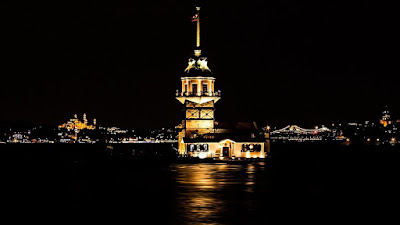
Maiden's Tower in Istanbul

On the 2010 book Harem Histories: Envisioning Places and Living Spaces, edited by Marilyn Booth:

The editor's introduction mentions the 1909 publication of Demetra Vaka Brown's Haremlik: Some Pages from the Life of Turkish Women. "If Vaka Brown exploited the drawing power of the harem as an image of exoticism and mystery for her North American friends and readers, she also sought to complicate that image for her readers, contrasting it with the 'hatred and scorn' she had heard Americans express toward Turkey, as they assured her that Turkish 'women [were] miserable creatures.'" And so this 2010 book, Harem Histories, asks how the harem and other "understandings of gendered space in the societies where the harem structured women's and men's lives" was represented in those societies. Not in outside societies that may have misunderstood or criticized it, but in the society of which the harem was a part, while acknowledging "perpetual cultural motion."

One of the essays is "Panoptic Bodies: Black Eunuchs as Guardians of the Topkapi Harem" by Jateen Lad.

  • "In the enormous corpus of European harem literature and paintings, sharp-eyed eunuchs became a mandatory topos, their presence at the margins bringing to light the perversity of the scenario which they helped frame: the perfect, fair-skinned, and beautiful being entrusted to the incomplete, dark, and mutilated." (p. 137)
  • The Topkapi harem was "precisely configured" and it was "all held together by a network of spaces guarded by the black eunuchs." (p. 150)
  • "Thus, despite the black eunuchs' position at the margins, the architecture suggests that they were central to all comunication within the harem." (p. 165)

Marilyn Booth, editor. Harem Histories: Envisioning Places and Living Spaces. Durham & London: Duke University Press, 2010.

Image of Maiden's Tower in Istanbul by Adem AY from Pixabay. Maiden's Tower is about 2 km across the water from Topkapi Palace.

Also of interest:

"Closed to the public for more than a decade, the stunning Zeyrek Çinili Hamam has just reopened its wooden doors to the world. Located in Istanbul’s Zeyrek neighborhood – on the European side of the Bosporus, adjacent to the historic Fatih district – the bathhouse was built in the 1530s by Mimar Sinan, the architect-in-chief to illustrious Ottoman sultans such as Suleiman the Magnificent."
The 500-year-old hamam bringing Istanbul’s past to life Alice Barnes-Brown, CNN, September 28, 2023

"The Hamam al-Samra, in the Al-Zeitoun neighborhood of northern Gaza, was said to have been built in the 14th century and was the only public bathhouse in the Gaza Strip. It was destroyed in an Israeli airstrike on December 15, [2023,] its owner, Salim Al-Wazeer, told CNN."
Israeli military acknowledges destroying Ottoman-era bathhouse while targeting Hamas in Gaza, Ibrahim Dahman and Stephanie Halasz, CNN, December 30, 2023


You may also be interested in my nonfiction books about how eunuchs are treated in fiction and in nonfiction:


If you'd like to learn more about my work, I've published books. Also, I write for Medium. There, readers with a paid membership don't have to worry about the paywall.